Disaster Costs, 1900–2024

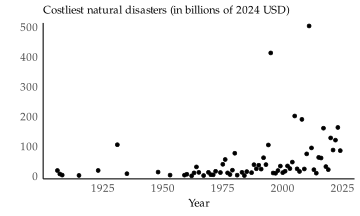
Here are the costliest natural disasters per year, since 1900. This covers only single events; it does not count longer-running processes like multi-year droughts.1 In insurance, things are typically considered single events if they unfold within 72 hours.
Plotting only the record-setting events, we get a step function.
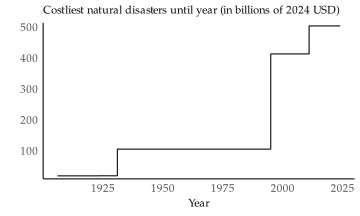
The first peak in 1931 is a large scale flooding of China, often cited as one of the deadliest natural disasters in history. It also held the record for the most expensive for a long time. In 1995 came the Kobe earthquake in Japan, which was replaced in 2011 by another earthquake that affected Japan. Both of these Japanese earthquakes got so expensive not only because of their high death toll (although that was also high) but because they damaged lots of construction and infrastructure – in the latter case even a nuclear power plant.
We could also draw a time series for man-made disasters, with the caveat that I did not spend very much time digging for these numbers, so there are a lot of events missing.
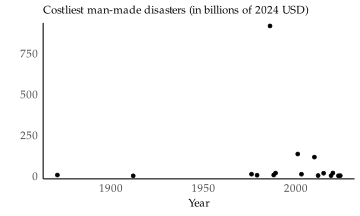
The big number in 1986 is the Chernobyl disaster. The two smaller big numbers just after 2000 are the September 11 terrorist attacks and the Deepwater Horizon explosion. Also this plot excludes long-running processes, like the contamination from Sellafield which would definitely make the cut if it happened all at once.
We can compare the inverse cumulative distribution functions of the costs of man-made and natural cause disasters to get a sense of how they differ in cost. The straightness of the lines on the log-scaled cost axis indicates they might follow power laws, which isn’t too surprising.
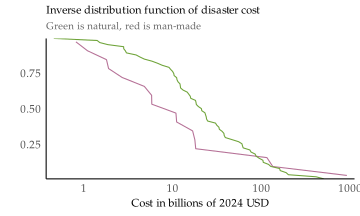
On this plot, it looks like humans are generally better than nature at not causing expensive disasters, but when we do mess up, we do it badly; recall that the last point on the green line is partially man-made.
We can try to verify numerically: since these numbers are the maxima for each year, we can fit a generalised extreme value distribution to them. We can then use that to derive what the average \(n\)-year disaster would look like, i.e. something so bad it only happens every \(n\) years.
We get the following table. I did not collect enough data on man-made disasters to compute levels beyond the 20-year timescale.
| Timescale | Natural | Man-made |
|---|---|---|
| 5-year disaster | $63,000,000,000 | $44,000,000,000 |
| 10-year disaster | $130,000,000,000 | $160,000,000,000 |
| 20-year disaster | $250,000,000,000 | $570,000,000,000 |
| 50-year disaster | $580,000,000,000 | — |
| 100-year disaster | $1,100,000,000,000 | — |
| 200-year disaster | $2,000,000,000,000 | — |
These huge numbers are hard to put in context. Recently, Hurricane Melissa reached Jamaica in one of the most powerful landfalls recorded in the Atlantic. It has wrecked large parts of the island, and its cost is currently estimated at $2.2–4.2 billion. The costs of even 5-year global disasters is staggering by comparison.
Part of this, of course, is that a natural disaster in a part of the world with expensive infrastructure (such as Japan) will cost more than if it hits a poorer country like Jamaica.
That as it may be, it is probably worse than it seems. We can tell from the first time series plot that natural disasters today tend to be worse than they used to be.
To explore this, we’ll pick a cutoff date of 1980, for reasons that are not at all related to plots of annual temperature anomalies.2 It also happens to divide our dataset neatly into nearly halves. We’ll name the period before 1980 the smallpox age and the period after it the pc age.3 Smallpox was officially eradicated in 1980, and the ibm pc was introduced in 1981. Plotting the distributions, we can see that the pc age is significantly worse than the smallpox age.

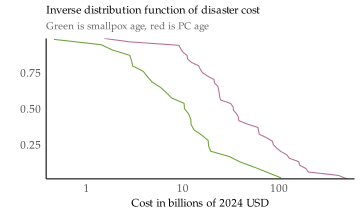
We can bring up one of them tables of block returns, too.
| Timescale | Smallpox age | pc age |
|---|---|---|
| 5-year disaster | $24,000,000,000 | $93,000,000,000 |
| 10-year disaster | $44,000,000,000 | $170,000,000,000 |
| 20-year disaster | $76,000,000,000 | $290,000,000,000 |
| 50-year disaster | $160,000,000,000 | $600,000,000,000 |
| 100-year disaster | $260,000,000,000 | $1,000,000,000,000 |
| 200-year disaster | $440,000,000,000 | $1,700,000,000,000 |
A 200-year disaster used to cost about the same as the highest cost we have on record, but now we can expect it to be almost four times as expensive, because we are building more complicated infrastructure and we are seeing worse natural disasters.
What’s the point of all this? Not much. There’s nothing you can do as an individual to make these costs lower.
But it is useful as a reference frame for large amounts of money. When someone says something like “The us paid $1.1 trillion for its 2003 invasion of Iraq,” you can think to yourself, “Okay, that’s like a paying for the repairs of a global 100-year natural disaster in the pc age.”