Snakes and Ladders
It is common1 In Sweden, at least. for promotional pamphlets aimed at children to contain a themed variant of snakes and ladders. This is the “game” where the players toss a die, move as many places as the die says, and then some spots on the board have an event that send the player forward, or back, or give them an extra toss or whatever.
The theme is typically related to whatever the promoter wants to promote, but styled for children. I get the appeal – for children. They can probably imagine they’re really travelling along the path! In the variant pictured below, there’s forest and water and tunnels and dogs and everything!
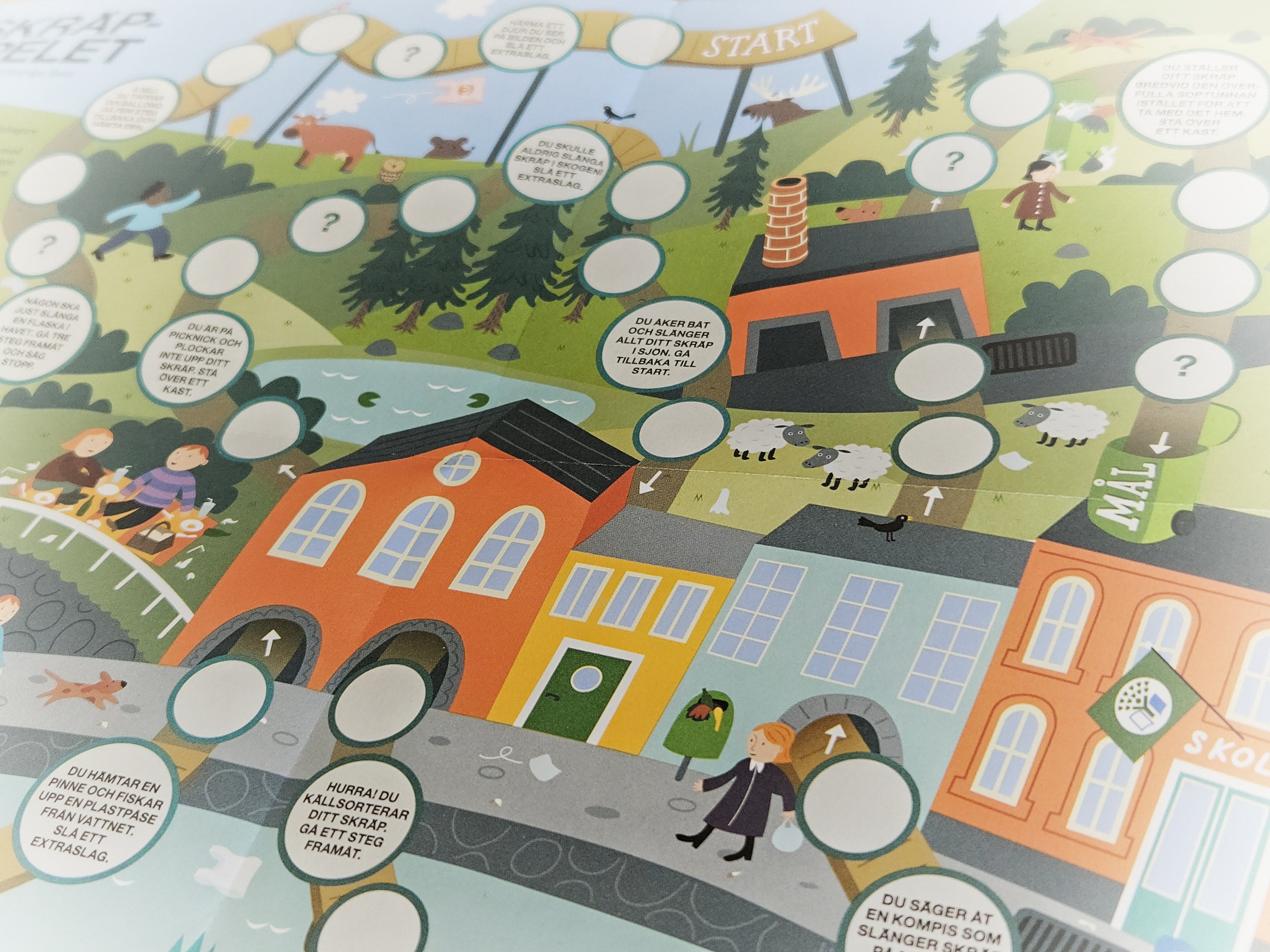
But as a game, it sucks. For everyone. My children hate losing, and these games have n−1 losers for every n players. There are also literally zero decisions for the players to make, so I cannot make it through even a few turns without zoning out.
Here’s how to make it slightly better. I haven’t analysed this for fairness, but it’s a good start. And it works for basically any promotional snakes and ladders board.
Rules for cooperative snakes and ladders
Each player has a pawn, starting at the starting point of the board. If all pawns get to the finish, the group has collectively won the game. If any player
- Lands on a snake head (a spot with a “bad” event, such as move backwards, skip a turn, etc.); or
- Ends up separated from any other player by more than five2 I haven’t spent a lot of time tweaking this number, but it should be in the right ballpark. spots
the group loses. That’s winning and losing.
Movement is not done with a die. Instead, six playing cards (ace to six) are placed face up on the table. Before a player moves, the team discusses which card they should use. When a card is selected, that card is flipped back-side up (to indicate that it has been used) and the player moves that many positions. The next player then gets to choose a card, with the previously used card unavailable for selection.
After a short while, one player will get a forced move, because there is only one face up card remaining. But since the players have discussed which cards to use in which order, hopefully that forced move is still good! After that move, all six cards are back-side up, and then they are all turned face up again and become available for selection for the next player.
This is an easy game. With a typical promotional snakes and ladders board, the team does not need much foresight to maintain cohesion, avoid snakes, and make it to the finish. But it still gives a veneer of decision-making to the participating adult, meaning it is slightly easier to stay engaged than a game that doesn’t even pretend to give the players any choice. And it’s still just as fun for children, if not more so, because now it’s a goal to stay together!
Optional extension: player roles
I haven’t tested it as much as the previous base game, but here is how the game can be made easier, yet more varied. At the start, players pick one role each. The roles come with a special ability, which can be used once per game, at any point during that player’s turn.
The names for these roles are highly provisional.
- The pusher’s special ability is to move any pawn on the board, rather than their own. This ability replaces the pusher’s ordinary movement, and thus must be used before they move.
- The sprinter’s special ability is to draw an extra movement card after they have moved. Their moves are executed sequentially, meaning they cannot be added together to skip over a snake.
- The banker’s special ability is that they can reset all movement cards to be face-up after they have moved, giving the next player the ability to choose between all cards. This ability is activated only after the banker has moved, meaning they cannot use it to increase their own options. When the banker resets the cards, that cancels any immunity put in place by the insurer. (See below.)
- The anchor’s special ability is to skip their turn, meaning they don’t remove a choice of movement card for the next person, and also don’t get too far ahead of the rest of the players.
- The cartographer’s special ability is reusing any already-used (back-side up) movement card. This card will be used for their ordinary movement, meaning the ability must be used before they move.
- The duplicator’s special ability is doubling the value of their movement card, executed as one move. In other words, this can be used to skip over a snake. This doubling happens as part of their ordinary movement, meaning the ability must be used before they move.
- The insurer’s special ability is declaring a snake safe. This immunity affects all players and lasts from when it is declared until the next time the movement cards reset. If the insurer uses this ability to survive a forced move (only one card remaining) the immunity expires immediately after they have moved (when the movement cards reset). If they use this ability after they have moved, even if that move leads to resetting all the cards, it lasts until the next time all cards reset.
- The gambler’s special ability is getting an extra movement after they’ve already moved, with the size of the movement is determined by random draw among the remaining face up movement cards. (Practically, one player shuffles them and holds them with the backs toward the gambler, who then draws one without knowing which one it is.)
These roles are not balanced at all – the gambler, for example, is strictly worse than the sprinter. However, some of them can lead to fun interactions, such as the insurer marking a snake in front of the gambler safe before the gambler makes use of their ability!